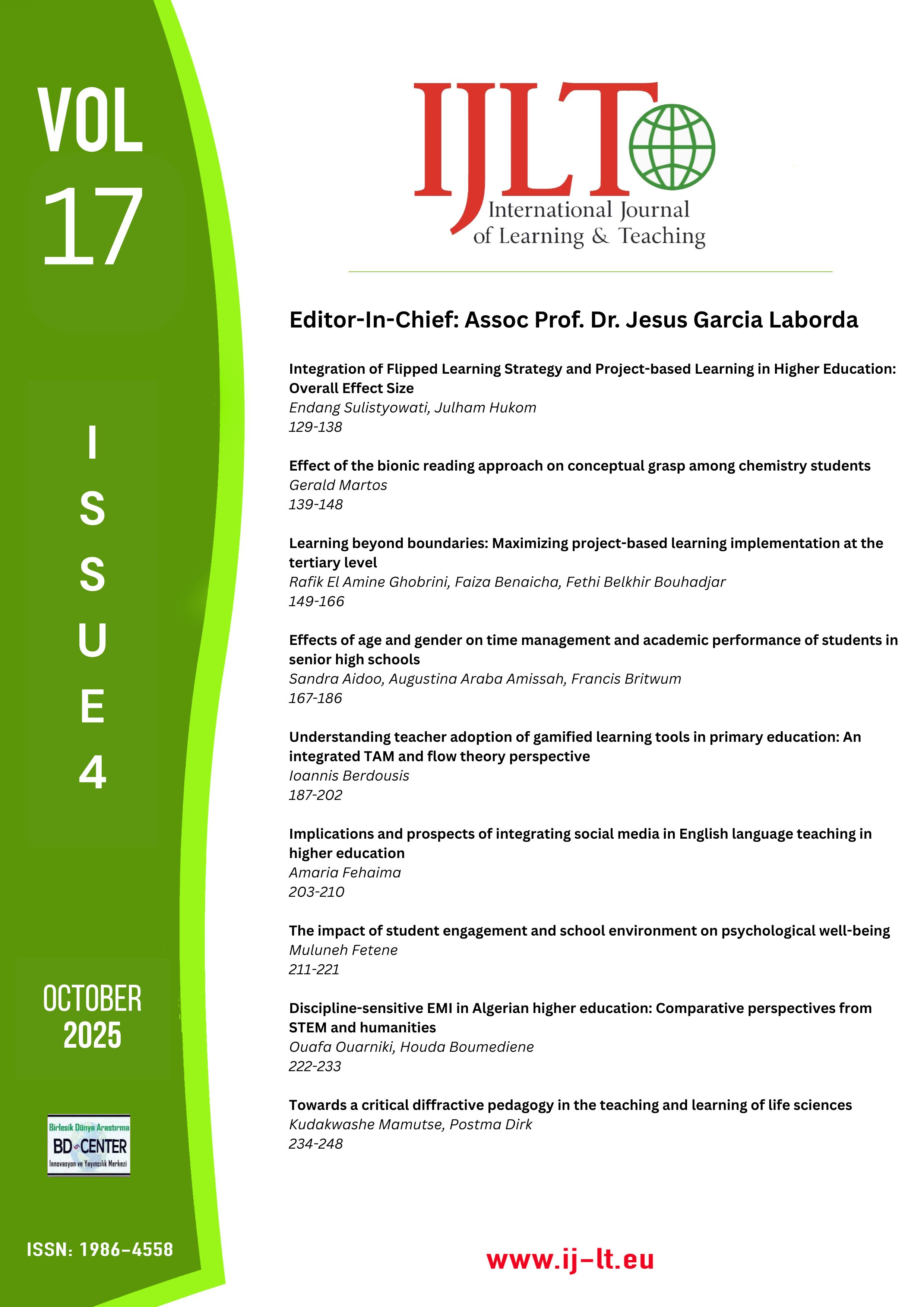
Integration of Flipped Learning Strategy and Project-based Learning in Higher Education: Overall Effect Size
Article Sidebar
Main Article Content
Abstract
This study aims to measure the overall effect size related to the effectiveness of the flipped learning strategy integrated with Project-Based Learning (FL-PjBL) on students' academic achievement in Higher Education. The method used is group contrast meta-analysis. A total of thirteen research samples (k = 13) that meet the inclusion criteria are included in this meta-analysis. The results of the meta-analysis indicate that the FL-PjBL strategy has a large and significant influence on students' academic achievement when compared to traditional learning strategies, with an overall effect size value of (d = 1.22; p < 0.01). However, the high level of heterogeneity (I² = 83.64%) indicates substantial variation between studies. Therefore, further research is recommended to investigate moderator variables such as educational level, subject area, intervention duration, and the quality of technology integration and project design in learning.
Keywords: Effect size ; flipped learning; Meta-Analisis; project-based Learning
Downloads
Article Details

This work is licensed under a Creative Commons Attribution-NonCommercial-NoDerivatives 4.0 International License.
Authors who publish with this journal agree to the following terms:
- Authors retain copyright and grant the journal right of first publication with the work simultaneously licensed under a Creative Commons Attribution License that allows others to share the work with an acknowledgement of the work's authorship and initial publication in this journal.
- Authors are able to enter into separate, additional contractual arrangements for the non-exclusive distribution of the journal's published version of the work (e.g., post it to an institutional repository or publish it in a book), with an acknowledgement of its initial publication in this journal.
- Authors are permitted and encouraged to post their work online (e.g., in institutional repositories or on their website) prior to and during the submission process, as it can lead to productive exchanges, as well as earlier and greater citation of published work (SeeThe Effect of Open Access).